Mission Design Maturity
Our teams deliver great design work, but this often relies heavily on the talent of an individual designer. New methodologies are introduced but they rarely become habits amongst all teams.
We sometimes jump into solutions, without taking the broader organizational context and user desires into consideration. Those solutions might work well in isolation, but could result in friction with other business processes, other products and user expectations.
How might we institutionalise design?
Benefit Hypothesis
Design thinking, problem solving and measuring design impact might sound rather abstract.
We would like to have a better understanding of our own design practices, and those in the industry. This might help us in defining how we can organise ourselves and what business value these adjustments might bring. The final outcome for this enabler is to map various options that can be considered and that might improve our design and analysis processes.
In addition, the long term goal is to deliver greater value to our business partners by increasing our design maturity. Spending time analysing the real need for a change, and defining performance metrics, can result in more balanced decision making, more sustainable solutions and happier customers and users. It will ultimately lead to a smaller application landscape, easier talent onboarding and lower run- and support costs.
Increasing the collaboration with customers, users, and other product teams, and involving them more in ideation and decision making, would reduce ‘design by assumption’ and increases the likelihood of a product that serves the right needs.
Particular methods would also enable us to measure the impact of changes. Product performance metrics can be put in place to track performance of a variety of aspects . This data can also support us in justifying strategic decisions or resource requests.
Context
Environment
Business Computing Group
CERN’s unit, responsible for the software that supports all admin processes and operations.
My Role
Business Computing Design Lead
Project initiated, led and executed by me, supported by my amazing colleagues.
Execution
Project approved for Q4 of 2020
In reality, this means that work done between:
November 2020 until February 2021
The mission
1. Proving the value of design
Challenge
Design is often seen as colours and workshops, instead of a culture and strategy.
Approach
Made a 5-minute Youtube video, that can easily be watched by those with a full calendar, sharing studies from IBM, McKinsey, Gartner etc. that prove the value of design. A summary of the studies was included as document.
Result
A foot in the door. An opportunity to work together with the managers that I want to influence.
2. Creating a Design Maturity Matrix
Challenge
Lack of awareness of what a mature design organization looks like, and what the benefits would be.
Approach
Analysed a variety of design maturity matrices from industry leaders and assembled a new matrix, tailored for our specific needs.
Result
Clear structure that can guide the stakeholder interviews and workshops.
3. Assessing our Design Maturity
Challenge
Scepticism towards the cost / benefit of design.
Approach
Let leadership and product managers assess the matrix and interviewed them to identify pain-points for each of the design aspects.
Result
Better understanding of what design is about and realisation that an increased design maturity would highly benefit the organization.
4. Analysing our Designers
Challenge
A hybrid role of Design and Business Analysis, often also responsible for Product Ownership, leads the team's direction.
Approach
Assembled a self-assessment model, covering aspects of all roles and let their supervisor interview them, such that they could complete the assessment together.
Result
Clear understanding of the experience, ambitions and pain-points for each designer.
Approach
Conducted "How Might We" workshop with senior leadership to keep them up-2-date and give them a chance to adjust the direction.
Result
5 How Might We questions that serve as directional foundation for the idiation phase.
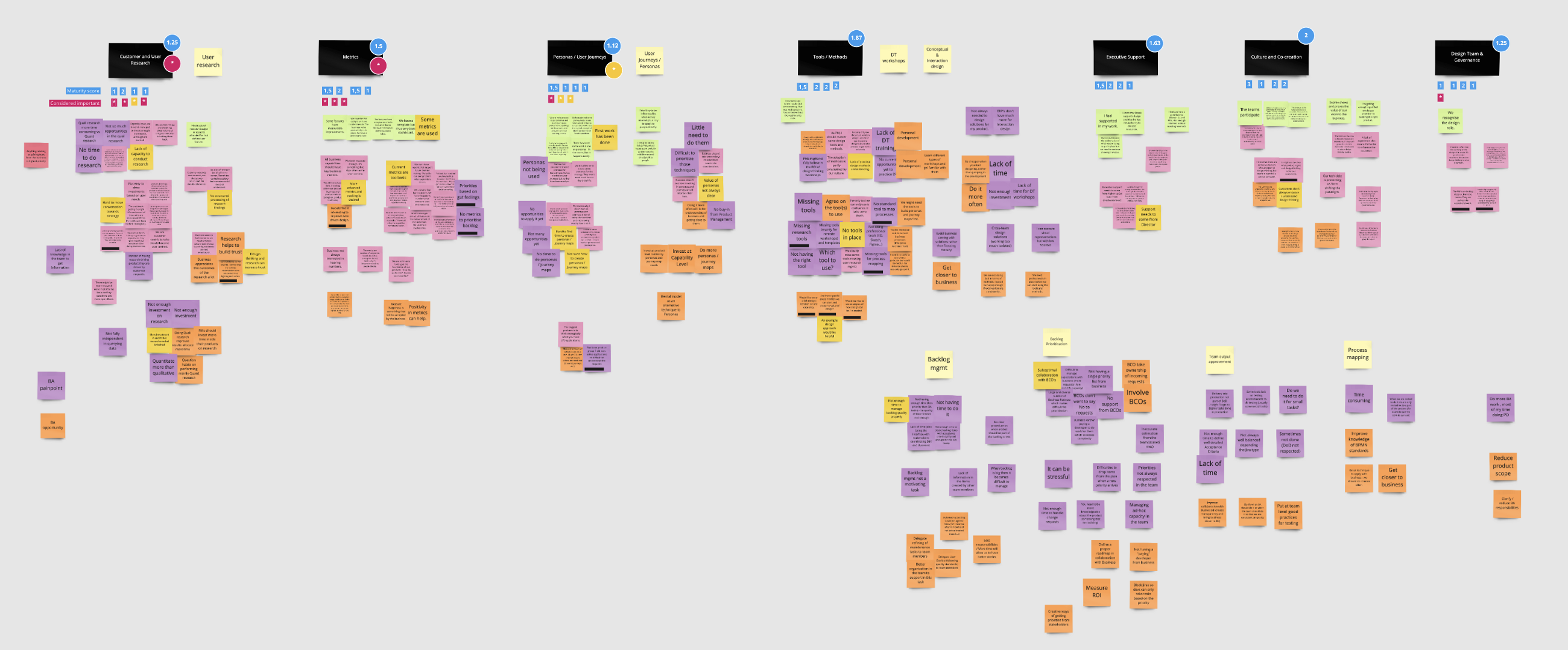
5. Analysing our Maturity
Challenge
Valuable transcriptions of interviews available, without clear conclusion.
Approach
Created a pain-point map, with anecdotes from all the conducted interviews.
Result
Clear patterns in our pain-points and understanding regarding our priorities: Metrics and User Research.
6. Defining How Might We's
Challenge
Senior leadership hasn't been much involved in the process.
Approach
Conducted "How Might We" workshop with senior leadership to keep them up-2-date and give them a chance to adjust the direction.
Result
5 How Might We questions that serve as directional foundation for the idiation phase.
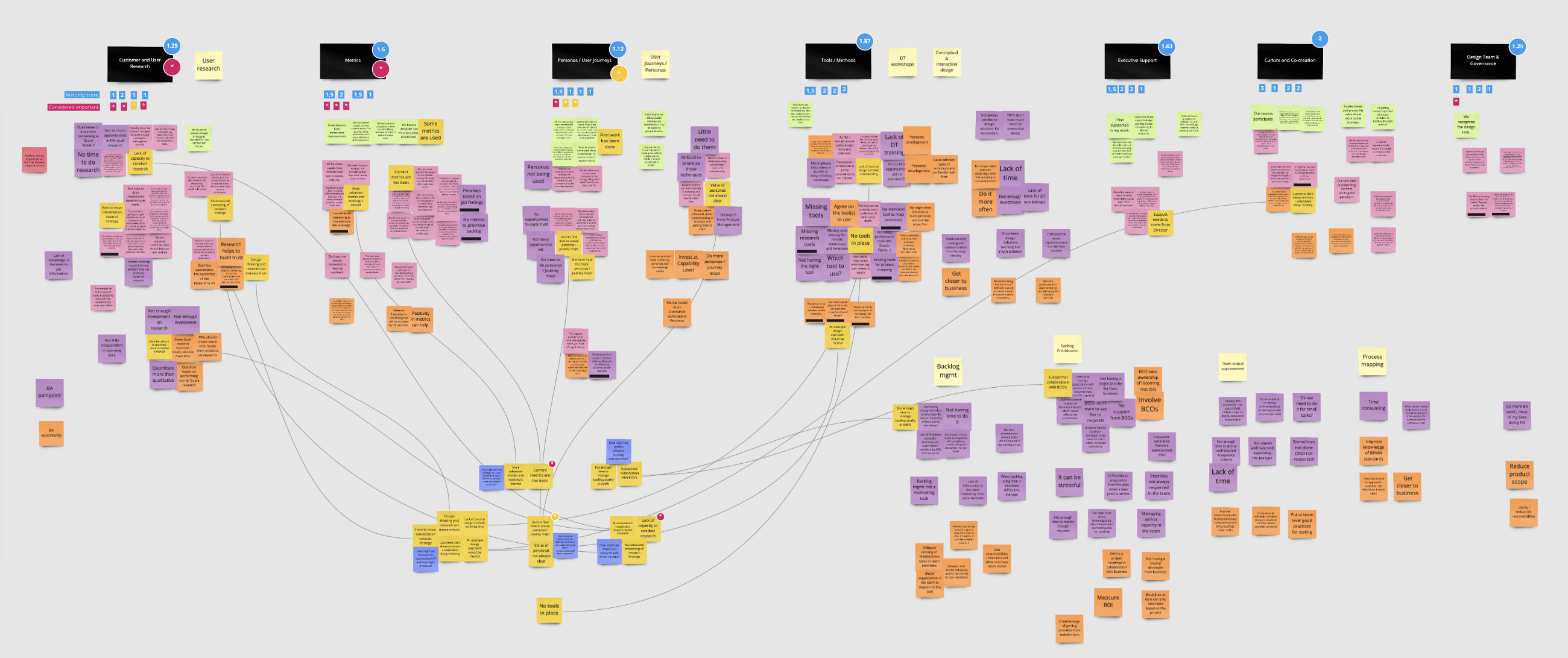
5. Analysing our Maturity
Challenge
Valuable transcriptions of interviews available, without clear conclusion.
Approach
Created a pain-point map, with anecdotes from all the conducted interviews.
Result
Clear patterns in our pain-points and understanding regarding our priorities: Metrics and User Research.
6. Defining How Might We's
Challenge
Senior leadership hasn't been much involved in the process.
Approach
Conducted "How Might We" workshop with senior leadership to keep them up-2-date and give them a chance to adjust the direction.
Result
5 How Might We questions that serve as directional foundation for the idiation phase.
7. Ideating the potential solutions
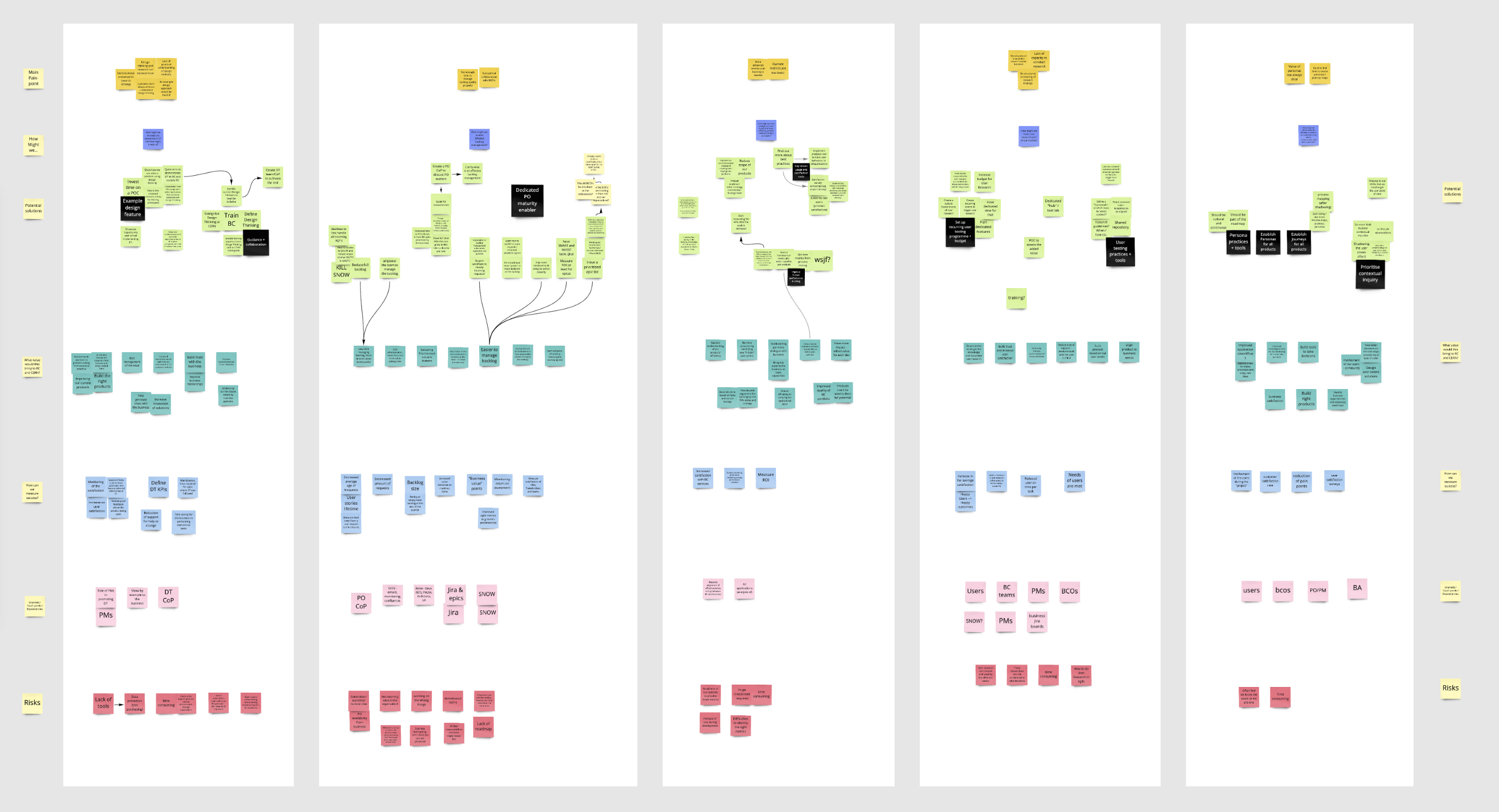
Challenge
-
Approach
Conducted 2 workshops with all designers to brainstorm about solutions that could solve the "How Might We" questions. Business Value, Metrics, Touch Points and Risks for each domain have been covered too.
Result
Rough ideas for all domains that could serve as building block for the roadmap.
8. Creating the Roadmap
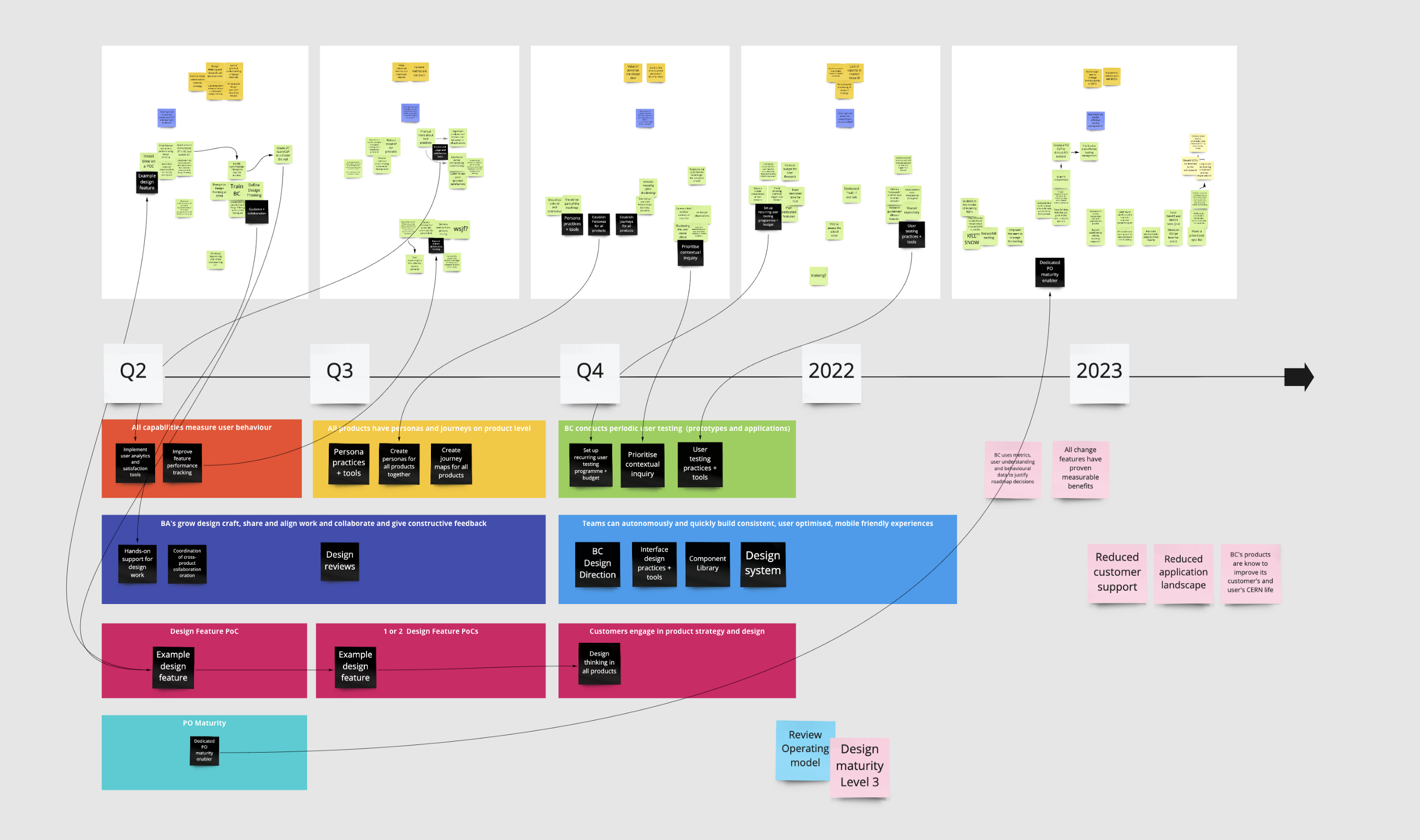
Challenge
-
Approach
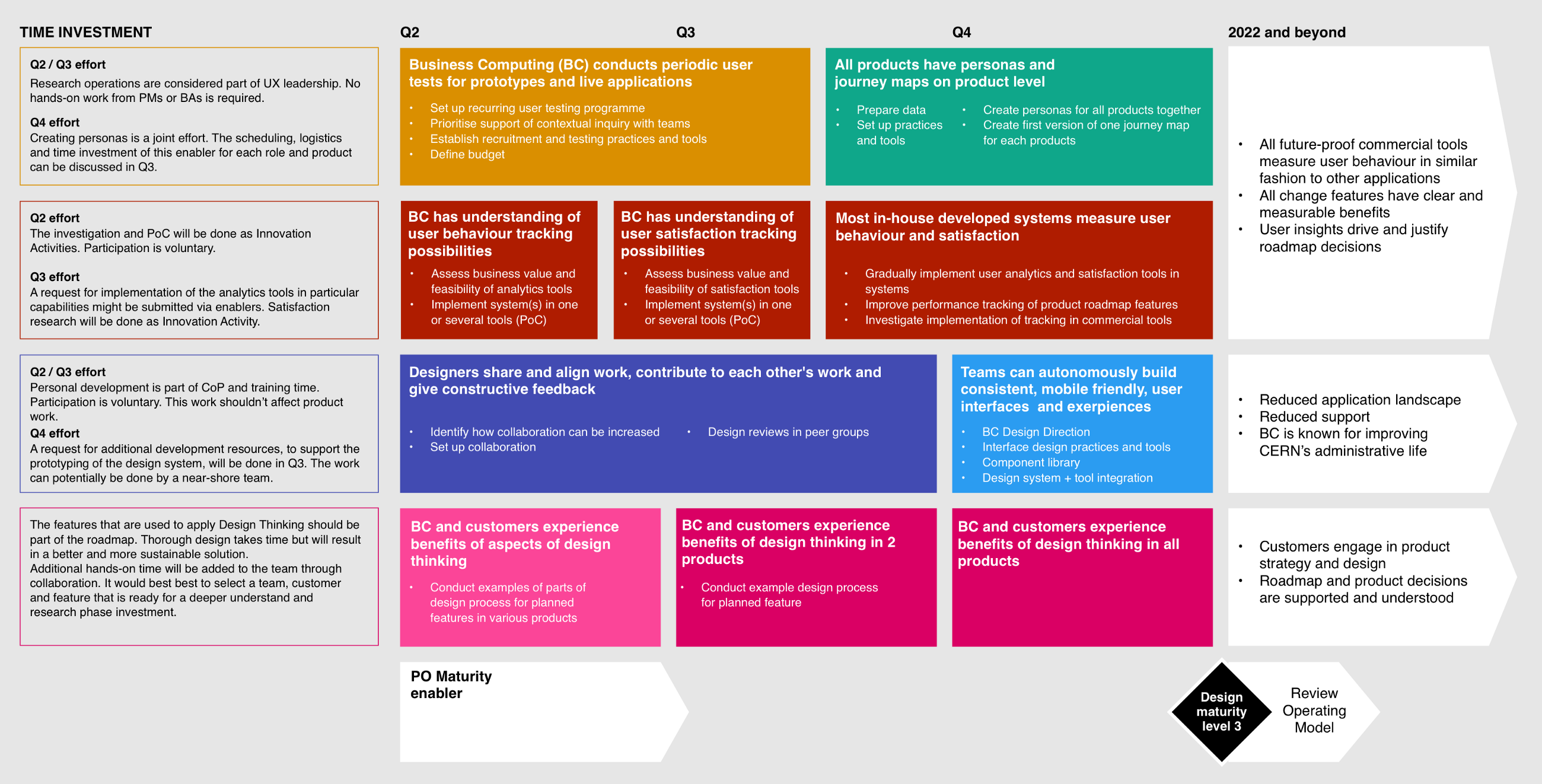
Took the priorities, derived from the initial interviews, as foundation. Added translated versions of the solutions, taken from the Ideation workshop, to the timeline. Aligned and supplemented it with our long-term design vision.
Result
Draft roadmap, covering all our needs, desires and vision.
9. Investigating Operating Models
Challenge
Uncertainty if approval for roadmap execution will be given and lack of resources to work on roadmap.
Approach
Adjusted the roadmap after input from all stakeholders. Lobbied talent from various backgrounds to work on specific elements of the roadmap.
Result
Final roadmap and alliances that are exited to work on the first stage of the design maturity mission.
10. Securing the future
Challenge
Uncertainty if approval for roadmap execution will be given and lack of resources to work on roadmap.
Approach
Adjusted the roadmap after input from all stakeholders. Lobbied talent from various backgrounds to work on specific elements of the roadmap.
Result
Final roadmap and alliances that are exited to work on the first stage of the design maturity mission.
Achievements
- Increased engagement with our customers, by involving them in a part of the workshops and otherwise by using business alignment workshops to facilitate decision making.
- Support of customers in moving from asking for solutions to sharing their business objectives.
- Utilised the unique talent and knowledge of a diverse group of participants and increases team cohesion.
- Designed products that are in the sweet spot of user desires, business objectives and technical feasibility.
- Democratised the design process and reduced the risk that individual designers or developers will be held responsible for a group effort.
- Made enterprise thinking more mobile minded.
Take Aways
- Design sprints are not the answer to everything. It’s a compromise of an elaborate design process but works well for particular challenges.
- Scoping is really important in all phases of the sprint. It’s tempting to try to solve too many issues at once.
- No workshop is the same. It’s ok to let the participants have an influence on the direction of the workshop, as long as the end objective is managed. Introducing unforeseen activities can be effective to ensure smooth progress.
- Reduced stakeholder investment works. The business alignment workshops were well received and stakeholders felt engaged and influential.
- Remote workshops work quite well, but attention needs to be paid to the informal aspect of the day. Facilitate coffee-talk conversations.
Head of Business Computing's opinion
Bas brings expertise and insights that bring together aspects of psychology, interaction design, customer experience, information architecture and engineering. The approach has been demonstrated by world leading organizations as the best ways to ensure the systems that we create efficiently meet the needs of the users.
While bringing new ideas to an ‘old’ organization can be challenging, Bas’s early positive results already reassure me that this approach of design thinking is the right way for our group to build a better understanding of user's needs, efficiently develop the most appropriate tool, and ultimately increase productivity and save money.
I was able to appreciate first-hand the power of some of the techniques. I have greatly appreciated Bas’ work, his human centric, insightful contributions have been a real asset to our work.